


.png)
Built for regulated industries
Secure digital products engineered for regulated industries.
SERVICES

Real
experience.
Engineering for businesses where reliability matters.
Secure digital products engineered for regulated industries.
Engineering for businesses where reliability matters.
A banking app, wallet, onboarding flow or internal approval process has to work with existing systems, security rules, compliance checks, transaction data and real users who expect everything to work every time.
%202.svg)

We work with banks, fintechs and regulated financial platforms to build products that are secure, usable and connected to the systems around them. Our role is to help teams deliver solutions that work reliably in everyday operations while meeting the technical, security and regulatory requirements that define the financial industry.
In finance, the product is only one part of the story. There are core systems. Risk rules. KYC checks. Payment flows. Audit trails. Security reviews. Legacy technology. Internal approvals. Support teams. And customers who do not care how complex the background is.
They just expect the product to work. That is why we do not treat financial products as normal apps. The screen matters, but the systems behind it matter just as much.
Some clients come to us with a customer facing platform. Others have an old internal process, a payment flow, a banking product, or a system that needs to connect better with everything around it.

Digital Banking Infrastructure

Payment Integrations
Regulatory Technologies
Financial Process Automation
Digital Identity
Next-Generation Financial Infrastructure
(1).avif)
We usually work close to the client’s own product, backend, architecture, compliance, security and business teams.That matters because financial projects rarely fail in one place.
Sometimes the issue is the API. Sometimes it is the approval flow. Sometimes compliance comes too late. Sometimes the user journey looks good, but the back office team cannot support it. Sometimes the system works, but no one can explain the audit trail. The work needs to sit close to the people who understand those details.
.svg)
.svg)
.svg)
.svg)
.svg)
.svg)
.svg)
.svg)
.svg)
.svg)
.svg)
.svg)
Financial products need to be secure, but they also need to be understandable.
You need to know who did what, when it happened, which data was used, which rules applied and what the system should do when something goes wrong.
So we pay attention to security, access control, traceability, audit trails, transaction status, data handling and how the product behaves in real operations.

Our teams have worked on mobile storytelling applications used by large international audiences.
Some of these projects were customer facing. Others were internal platforms that helped teams manage daily work, content, users, orders or operations.
During a core system upgrade and bank merger, OTP had to keep mobile and web banking reliable for real customers while the systems behind it were changing.
Our team helped build and launch the new mobile and web platforms, including the design system, digital onboarding, Apple Pay and Google Pay integrations that brought everyday payments into the wider banking experience.
Since then, we have continued to evolve the platforms with accessibility improvements, stronger authentication and changes that make everyday banking more efficient for customers and the bank.
Best-rated Slovenian mobile banking app across iOS & Android
Mobile app installations

.png)
Loan and guarantee processes are rarely simple. Gorenjska Banka needed one place where business client managers could see the full client picture, follow each process and move work forward without switching between multiple systems.
As part of Gorenjska Banka’s process automation, we used Appian to build a digital entry point that brings together a 360-degree client view, guided workflows, automated credit assessment, document generation and backend integrations.
The solution reduced manual work, improved traceability and cut the average approval time from several days to less than one day.
Fastest quick-loan approval
Fewer clicks for quick loan handling
Sparkasse needed to modernise the mobile foundation of D-Mobile without disrupting the experience its existing cardholders already trusted. We rebuilt the native iOS application from the ground up, preserving established user journeys and backend integrations while re-architecting the app around Apple Pay card provisioning.
Behind a deliberately familiar interface, the work reached deep into the payment stack: card systems, authentication, device binding, security rules, provisioning flows and the underlying payment infrastructure. Cardholders can bring their cards into Apple Wallet through all three provisioning paths: manual entry, in-app "Add to Apple Wallet", and provisioning to paired devices, and pay directly from Apple Watch, with the same security guarantees enforced end to end.
The result is a payment experience that feels effortless to the user and is engineered to bank-grade standards underneath.
.png)
.png)
RockWallet brings account setup, buying, selling, swapping, sending and receiving assets into one wallet. These journeys had to remain easy to follow while meeting the security and regulatory requirements behind them.
We brought identity verification, biometric authentication, external verification services and transaction monitoring into the wallet, helping users complete the necessary checks without unnecessary friction.
For users, the experience stayed clear. Behind the scenes, the platform could apply stronger controls around access, transactions and advanced wallet features.
Secure onboarding and verification flows
Quick wallet setup
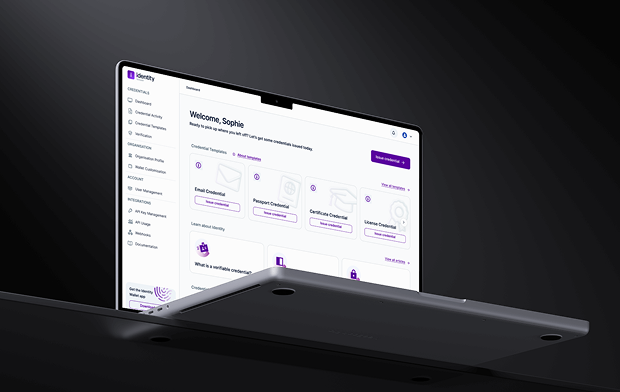
Digital verification should not require people to share the same personal data again and again.
We built a blockchain-based identity wallet, together with issuer and verifier platforms that allow organisations to issue tamper-proof Verifiable Credentials based on W3C standards.
Users store credentials on their own device and share only the proof a verifier needs, from identity and licences to KYC checks, workforce credentials or academic certificates.
Built to verify millions of credentials
To verify a credential

.png)
(1).png)
Digital signatures should provide more than confirmation that someone clicked “sign”. Organisations also need reliable proof of what was signed, by whom and whether the document was changed afterwards.
We built a digital signing platform where documents can be prepared, shared and signed through a familiar workflow. Each signature creates independent cryptographic proof that can be checked without relying solely on the signing platform.
Only a digital fingerprint of the document is recorded, never its contents. This keeps sensitive information private while making any later modification detectable.
CBDC projects need more than a technical proof of concept. They have to connect policy requirements, transaction flows, identity, security and existing financial systems.
Together with Otranto, we delivered a CBDC pilot for a Teranode client, combining our engineering capabilities with Otranto’s experience in central bank strategy and policy.
The pilot was showcased at the CBDC Conference in Istanbul in September 2024 and demonstrated how digital currency infrastructure can move from concept to a working, testable platform.
.png)
(4).png)
Copyright © Equaleyes 2026

.svg)


