



Built for regulated industries
Secure digital products engineered for regulated industries.
SERVICES

Real
experience.
Engineering for businesses where reliability matters.
Secure digital products engineered for regulated industries.
Engineering for businesses where reliability matters.
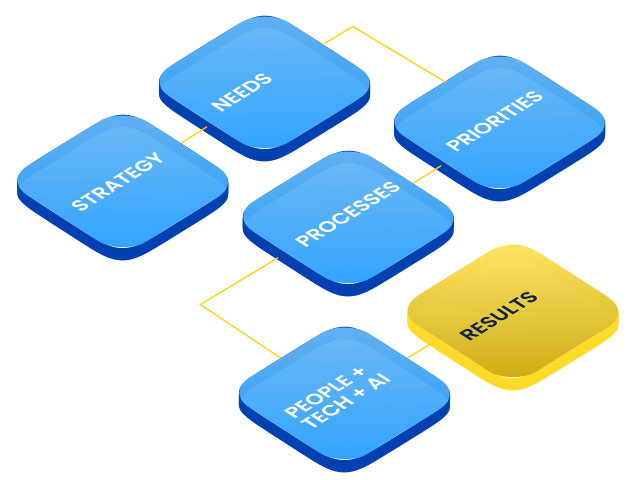









We are BPM and process automation experts across multiple platforms. But our job is not simply to automate existing processes.
We first look at how work moves through the organisation, where it slows down and where people are doing work that technology could handle better. Then we decide what should change and what should be automated.
Every organisation runs four kinds of processes: the ones that create value for customers directly, the ones that set direction, the ones that manage risk and compliance, and the ones that keep the business running.
We look at how these processes connect before focusing on a single workflow.
When the same approval, identity check or document step appears in several places, we look for ways to design it once and reuse it instead of rebuilding the same logic across different systems.

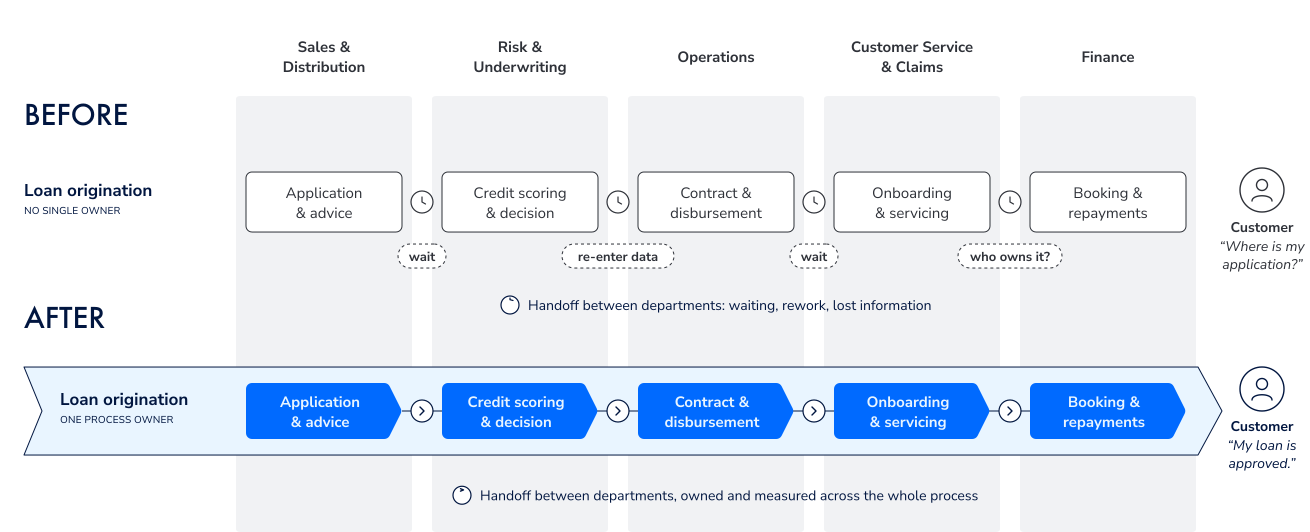
Improving one part of a process does not necessarily improve the whole process.
A faster claims team does not help much if the work then waits somewhere else. We look at how work moves between teams, where responsibilities change and where bottlenecks appear.
The goal is to make sure individual improvements contribute to the same business outcome.
Organisations don't win because one department is polished. They win because the whole system moves together.
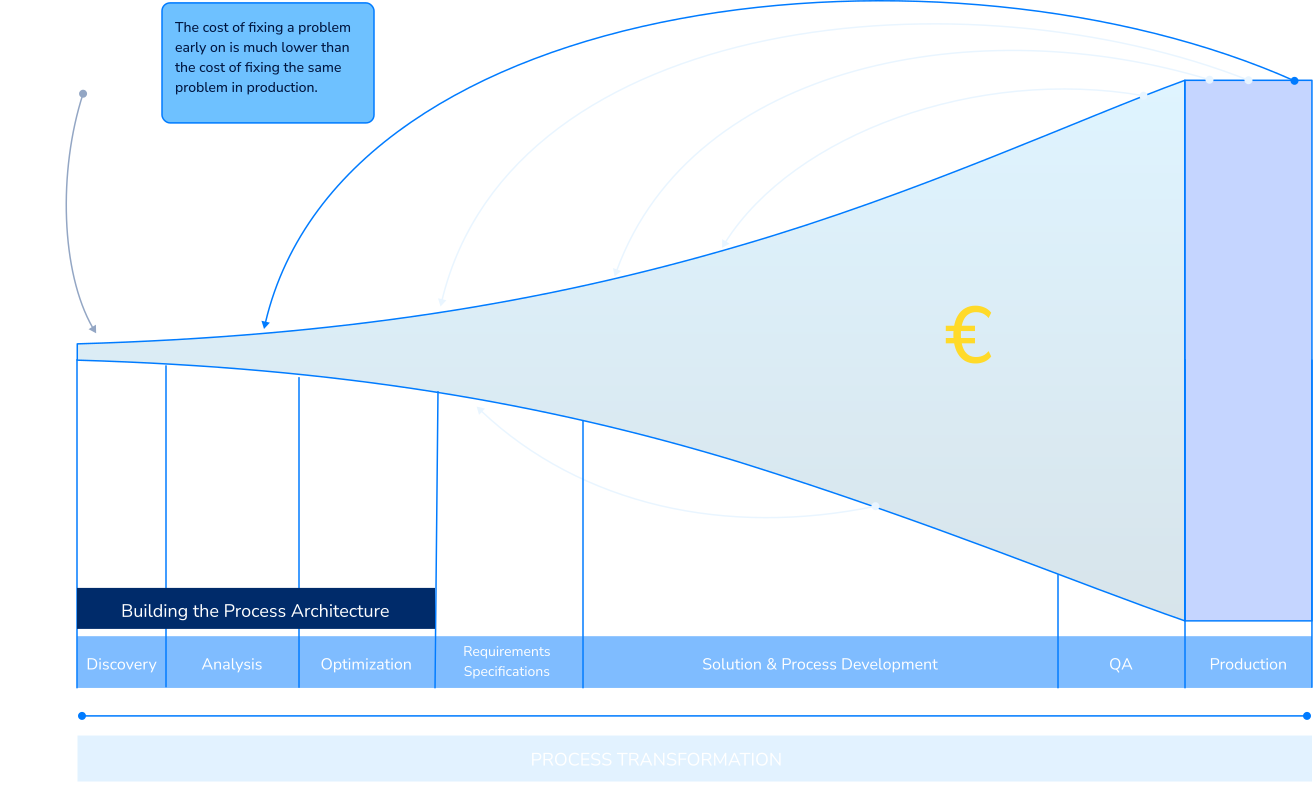
Automation projects become expensive when unclear requirements, approval rules and manual workarounds are discovered only after development has started.
We begin with discovery, analysis and optimisation so these problems can be found while they are still easier and cheaper to change.
Our process moves through six stages: Discover, Analyse, Optimise, Design, Build and Test, and Production. By the time a traditional approach is only starting, at Design, we have already found and fixed what it would otherwise only discovered in production.
Regulations change. Customer expectations change. Technology changes.
We design processes and systems so they can adapt without being rebuilt every time something around them changes.
That means thinking about flexibility, clear ownership and reusable components from the start.

Holds up under pressure — keeps working when conditions get harder
Built from tested, reused process atoms and governed checkpoints that catch problems before they become failures.

Recovers fast — absorbs a shock without a major failure
Modular by design, so a failure in one piece doesn't cascade — clear ownership means recovery is routed immediately, not improvised.

Evolves on purpose — changes shape as priorities change, without a rebuild
Built from reusable process atoms (SOPA) that recombine into new flows when priorities change — no rebuild required.
Instead of optimising only for today's requirements, we design flexible processes, modular architectures, and scalable operating models built to support continuous change. That is what process architecture is for — it's the discipline that makes resilience, robustness, and adaptability something you design for, not something you hope for.
Once a process is running, teams need to see what is happening inside it.
Who owns it. Where work is waiting. What failed. What was approved. And where the process can still improve.
We build traceability, audit logs and operational visibility into workflows from the start, so improvement can continue after launch.
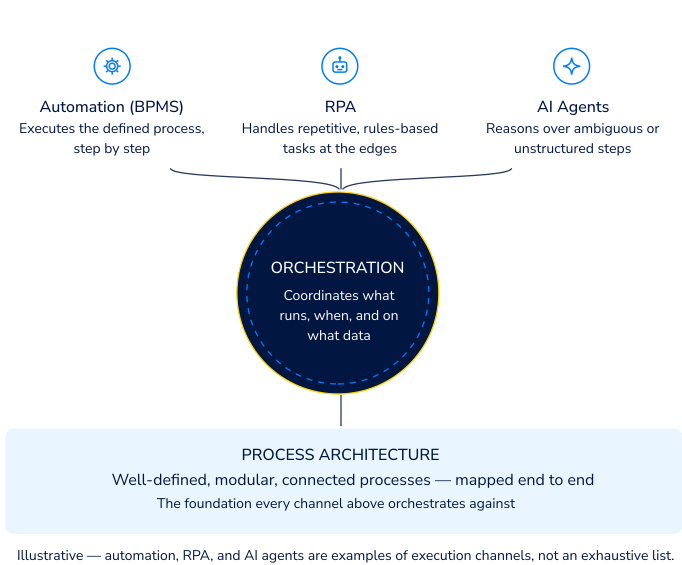
AI creates value when it becomes part of how the business works, not when it is added as an isolated feature and expected to somehow transform the organization.
A process gives AI context: when to act, what information to use, which decisions it can make, when a human needs to step in, and what happens next. Orchestration connects AI agents, people, systems and automation into one controlled end-to-end flow.
Without that structure, AI remains a collection of experiments. With it, AI becomes part of the operating model: measurable, governed and scalable.
Proves: AI that delivers business value
Once the process architecture is defined, we automate the process on a BPMS platform that fits your environment, such as Appian, Camunda or Pega, and scale it as your needs grow.




Camunda is often a good fit when a client wants process orchestration that can sit inside their existing architecture. It gives teams a lot of flexibility, but that also means there is more to design and build around it.
That is where we usually help. Our teams can support Camunda based projects with process modelling, backend integrations, task handling, user interfaces, monitoring, reporting and the operational tools around the workflow.

Appian is a different type of BPM and automation platform. It can be a good fit when the client wants more built in platform capabilities, faster configuration and a low code environment for building process applications.
Our teams have Appian delivery experience and certified Appian developers who have worked on banking and enterprise automation projects.
We can help with process analysis, workflow design, interfaces, backend integrations and long term support of Appian based systems.

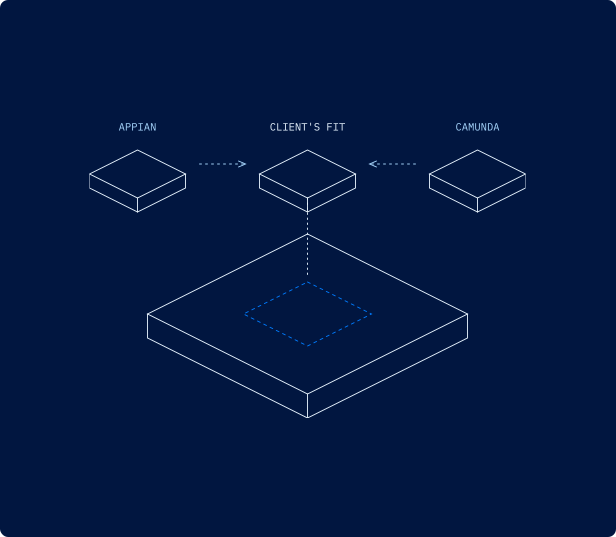
We do not think one BPM platform is right for every client. Sometimes Appian makes sense. Sometimes Camunda makes more sense. Sometimes the client has already made the platform decision and needs a team that can deliver around it.
The choice depends on the architecture, licensing model, internal team, security requirements and how the platform will be operated later. For us, the tool is only one part of the work. The real question is how the workflow connects with users, backend systems, documents, approvals, reporting, compliance and daily operations.
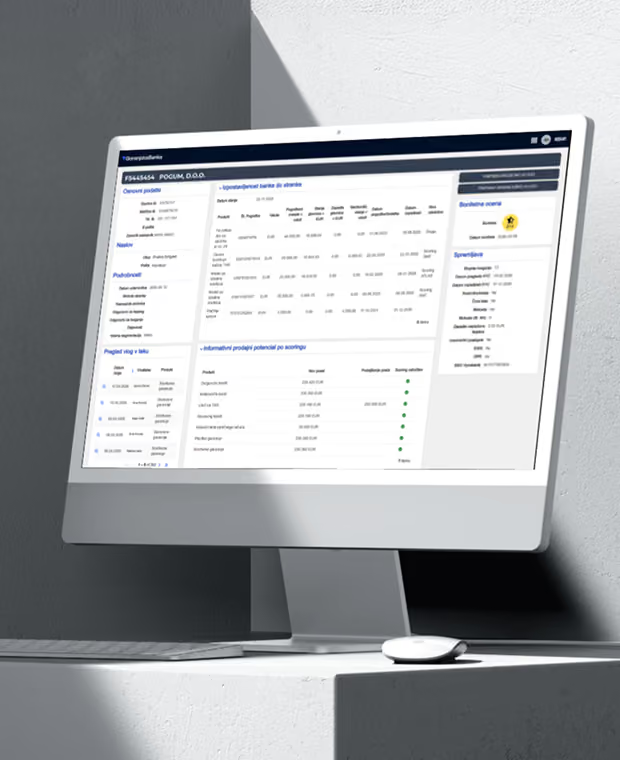
Loan and guarantee processes are rarely simple. Gorenjska Banka needed one place where business client managers could see the full client picture, follow each process and move work forward without switching between multiple systems.
As part of Gorenjska Banka’s process automation, we used Appian to build a digital entry point that brings together a 360-degree client view, guided workflows, automated credit assessment, document generation and backend integrations.
The solution reduced manual work, improved traceability and cut the average approval time from several days to less than one day.
Fastest quick-loan approval
Fewer clicks for quick loan handling
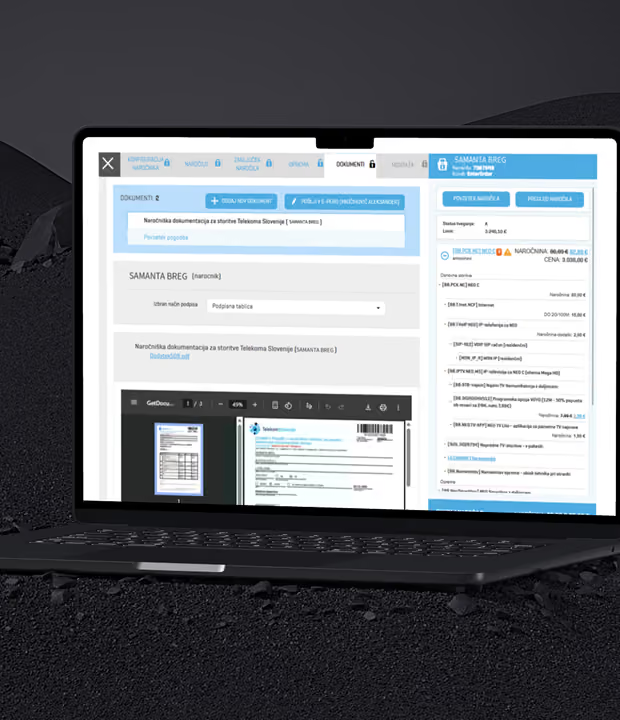
Since 2004, we have helped Telekom Slovenije evolve systems for order capture and commercial order processing.
The platform connects product rules, order flows, sales channels, credit checks, equipment, delivery, field work, technical upgrades and APIs for new digital products.
By bringing these parts into one process, the platform gave teams better visibility and made it easier to adapt order handling as products, rules and customer needs changed.
Long-term technology partnership
Faster order completion
Copyright © Equaleyes 2026



